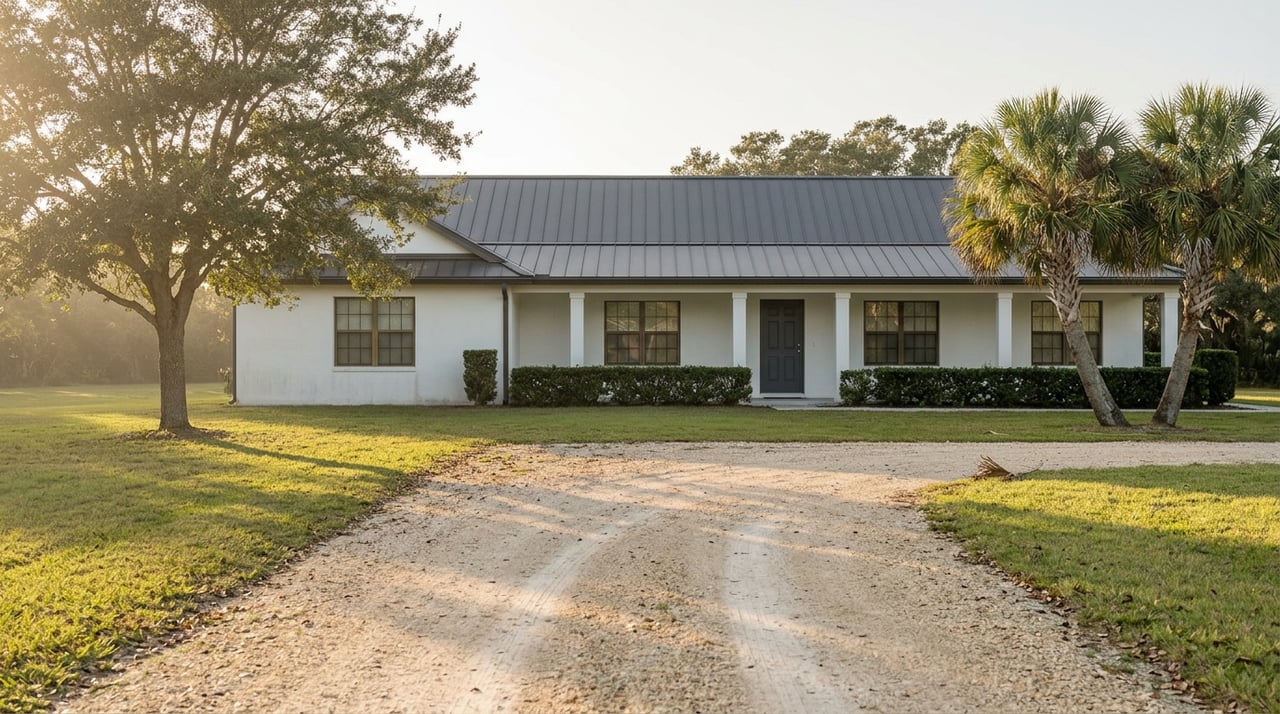
The Jupiter Farms Median Doesn't Mean What You Think It Means
August 13, 2026
August 13, 2026
Ask four different sources what a home in Jupiter Farms costs right now and you'll get four different answers. One puts the median at $958,000 for homes that closed in March 2026, up 21.7 percent from a year earlier. Another, built from 193 closed sales over the trailing twelve months through mid-May 2026, lands at $860,000. Two more trailing-twelve-month snapshots split the difference at $924,950 and $875,000.
None of these numbers is wrong. That's the problem. In a market this small, with this much variation in what a parcel actually contains, the median stops being a useful shorthand and starts being noise. If you're comparing a specific 1.25-acre listing against "the Jupiter Farms median," you're comparing it against a number that doesn't describe any real property in the neighborhood. The number that actually predicts what you'll pay, and what you'll deal with after closing, comes from three things no portal median captures: how much of the lot is usable, what's running the water and waste, and which special taxing district owns the road out front.
Jupiter Farms sells in a wider band than almost anywhere else in northern Palm Beach County, and the spread isn't random. A recent buyer-agent analysis of 193 closed sales over the prior twelve months found that entry-level homes (under $700,000) average about 1.2 acres, mid-tier homes ($700,000 to $1 million) average 1.43 acres, and homes above $1 million average 2.07 acres. Acreage size correlates with price, but so does acreage quality. That same analysis flagged retention ponds that consume half a lot as a documented drag on resale value, and named CBS construction, a roof under ten years old, and impact windows as the difference between a home that insures easily and one that doesn't.
Days on market tell a version of the same story from a different angle. The 193-sale analysis put entry-level homes at a median of 28 days on market and homes over $1 million at 62 days, with the $700,000 to $1 million tier making up 43 percent of all sales and a 96.2 percent list-to-sale ratio, the tightest of any bracket. Redfin's March 2026 snapshot shows something more dramatic: average days on market at 122, more than double the 62 days recorded a year earlier, alongside a drop from 24 closed sales to 12 in the same month. Both things can be true at once. The middle of the market is still moving fast and paying close to asking. The edges, particularly the high end and anything with deferred maintenance, are sitting.
| Source | Window | Median Price | Notes |
|---|---|---|---|
| Trailing 12-month sales analysis (193 closings) | Through mid-May 2026 | $860,000 | 43-day median days on market |
| National portal snapshot | March 2026 | $958,000 | Days on market up to 122 from 62 a year prior |
| Portal acreage filter | Trailing 12 months | $924,950 | Land-for-sale filter |
| Portal acreage filter | Trailing 12 months | $875,000 | Homes-with-acreage filter |
The gap between these numbers is the size of a down payment. Treat any single one as gospel and you'll either overpay against a comp that doesn't match your parcel, or underbid on a property that's genuinely worth more because the acreage is high and dry, cleared, and fenced.
Most of Jupiter Farms runs on private wells and onsite septic rather than municipal water and sewer. That's the standard, not the exception, and it changes what an inspection period is for. A licensed septic evaluation and a well water test belong in every contract here, and if you're planning heavy irrigation, a barn with wash stalls, or an accessory dwelling, add a pump-yield test to confirm the well can support the additional draw.
This is also where deals get renegotiated. The same 193-sale analysis put it plainly for buyers new to acreage: cosmetic wear is fine, but structural or mechanical deferred maintenance, meaning an aging septic field, a failing well pump, or a roof past its useful life, is the risk that actually costs money after closing. Sellers here are expected to produce a clean inspection or address the findings before the contract moves forward. A buyer who skips the well and septic line items to save a week in due diligence is the buyer who calls a septic contractor three months after moving in.
Anyone relocating from a neighborhood with a homeowners association is used to reading HOA disclosures. Jupiter Farms mostly doesn't have one. The vast majority of the community carries no mandatory HOA at all, with Ranch Colony, a gated enclave inside the Jupiter Farms boundary, as the main exception. What buyers from municipally-served areas often miss instead is the South Indian River Water Control District, a special taxing district that manages drainage and road maintenance across the community and assesses every landowner annually for it.
The district maintains over 96 miles of hard-surfaced roads and more than 92 miles of unpaved dirt roads within its boundaries, and landowners are assessed each year for both.
That assessment shows up on the tax bill, not in a homeowner association ledger, so it's easy to overlook until closing. It also isn't static. The district is actively working right now: ongoing road maintenance updates posted this year describe canal vegetation clearing on Canal 6 and a December 2025 coordination meeting with the Florida Department of Transportation's Turnpike expansion team, plus a grant application filed after a tornado spun off Hurricane Milton hit Jupiter Farms in the fall of 2024. None of this is disclosed the way an HOA estoppel letter would be. It's worth asking directly whether a specific road is paved, unpaved, or under a private maintenance agreement, since dirt roads and paved roads carry different assessment levels and paving a dirt road requires a majority-landowner petition and referendum under the district's process, not a unilateral county decision.
Jupiter Farms is zoned predominantly Agricultural Residential (AR), which permits private stables and horse-keeping by right on most lots, subject to setback and intensity standards in the county's Unified Land Development Code. Two things trip up buyers who assume more than the zoning grants.
The first is accessory dwellings. Palm Beach County allows one owner-occupied Accessory Quarters, commonly called an ADU, on lots over an acre. The unit is capped at 1,000 square feet of air-conditioned space plus up to 500 square feet under roof for a garage or covered porch, must sit at least 25 feet from side and rear property lines and 100 feet from the front line, cannot carry a separate electric meter, and has to remain under the same ownership as the main house. A guest cottage plan that ignores these numbers can stall a permit for months.
The second is the agricultural tax classification. Keeping a horse or two on your own acreage is allowed under AR zoning, but it does not, by itself, qualify a property for Florida's agricultural (greenbelt) tax classification. That classification requires bona fide commercial agricultural use under state statute, verified by the Palm Beach County Property Appraiser, not a hobby paddock. Buyers who factor a lower tax bill into their budget based on the presence of horses are often working from a misread of the rule.
Does Jupiter Farms have a homeowners association? Most of the community does not carry a mandatory HOA. Ranch Colony, a gated section within Jupiter Farms' boundaries, is the primary exception and functions as a separate, HOA-governed enclave.
Who maintains the roads if there's no HOA? Roads fall into three categories: county-maintained public roads, roads maintained by the South Indian River Water Control District, and private roads maintained by the adjoining property owners. Title work should confirm which category applies to a specific parcel before closing.
Can I lower my property taxes by keeping horses on my land? Not automatically. Florida's agricultural tax classification requires bona fide commercial agricultural use as defined by state statute and verified by the county Property Appraiser. Recreational or hobby horse-keeping on a residential lot does not qualify on its own.
If you're comparing specific Jupiter Farms parcels and want someone who can read a SIRWCD assessment history and a septic report as fast as a listing sheet, George Richetelli has spent years working this exact market. Schedule a consultation before you write the offer, not after the inspection period surfaces a problem you didn't know to ask about.
Stay up to date on the latest real estate trends.
Real estate done with purpose—rooted in experience, empathy, and authentic connection. Every client is treated like a neighbor, with thoughtful guidance and local insight shaping every step toward home.
TRUSTED PROPERTY ADVISORS

The Richetelli Group
5370 Donald Ross Rd Palm Beach Gardens FL 33418